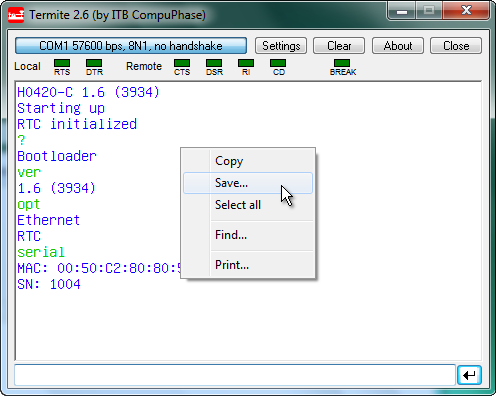
Ubuntu Serial Port Sniffer Cable
's • No support requests - This is not a support forum! Head to or for support or help.
Looking for a distro? • No spamblog submissions - Posts that are identified as either blog-spam, a link aggregator, or an otherwise low-effort website are to be removed. • No memes, image macros or rage comics - Meme posts are not allowed in. Feel free to post over at instead. • Reddiquette, trolling, or poor discussion - asks all users follow Top violations of this rule are trolling, starting a flamewar, or not 'remembering the human' aka being hostile or incredibly impolite. • Relevance to community - Posts should follow what the community likes: GNU/Linux, Linux kernel itself, the developers of the kernel or open source applications, any application on Linux, and more. Take some time to get the feel of the subreddit if you're not sure!
• Spamming self-promotion and surveys - Submitting your own original content is welcome on, but we do ask that you contribute more than just your own content to the subreddit as well as require you to interact with the comments of your submission. Additionally, surveys are not allowed.
Prozac nation download torrent legendado free. Sniffer (C) All connections are set as 9600 N81. Device (A) is connected to Sniffer (C) with a null modem (crossed serial cable) on port /dev/ttyUSB1 of Sniffer (C). Host (B) is connected to Sniffer (C) with a null modem (crossed serial cable) on port /dev/ttyUSB0 of Sniffer (C). On Sniffer (C), launch the slsnif program with the following.
• No misdirecting links, sites that require a login, or URL shorteners - In short: if your link doesn't go right to the content it will be removed. • No NSFW GNU/Linux is a free and open source software operating system for computers. The operating system is a collection of the basic instructions that tell the electronic parts of the computer what to do and how to work.
Free, Libre and open source software (FLOSS) means that everyone has the freedom to use it, see how it works, and change it. GNU/Linux is a collaborative effort between the GNU project, formed in 1983 to develop the GNU operating system and the development team of Linux, a kernel. Initially Linux was intended to develop into an operating system of its own, but these plans were shelved somewhere along the way. Linux is also used without GNU in embedded systems, mobile phones and appliances, often with BusyBox or other such embedded tools.
• • • Join us on IRC at # on freenode.net! Don't post image-macros, rage comics, or other drivel here. AMA • • • • • • • GNU/Linux resources: GNU/Linux Related: • • • • • • / / • • / • / • • Distributions: • • • / • / • • • • • • • • • • • / • • • • • Linux on Mobile: • • • • / • • • • Movements: • • • • Desktop Environments: • • / • • • / • Window Managers: • • • • • • Learning: • • • • • • Webcasts: • • • • • • Creativity: • • • • • • • • • Other operating systems: • • • • • • • • • • Don't see your community listed?
Or a subreddit for it, and when it has over 350 subscribers, and we'll add it to the sidebar. Yes, absolutely.
Reverse engineering serial protocols is definitely one of the most important applications for our serial monitor. As for Wireshark, here's the thing. Obviously, at the moment IO Ninja is not anywhere near Wireshark in term of the number of supported protocols. However, there is one important feature which, I believe, Wireshark will never have. IO Ninja is capable of merging incoming and outgoing packets and displaying them side-by-side with informational/warning/error messages thus forming a single, clean, searchable log sheet; you can search this log for patterns even if they span across inter-packet boundaries. Obviously, sometimes the traditional (packet-list + packet-details-view) approach of Wireshark is better. But I hope you can agree that there are situations when seeing the actual data stream is crucial (hence, we have features like 'Follow TCP Stream' in Wireshark -- but then again, it's NOT LIVE and not nearly as feature-rich as the log in IO Ninja).
Hm, the Linux kernel code here is 'interesting' to say the least. Hint, you never want to 'hook' a syscall, that way lies madness and lots and lots of incompatibilities and major problems with the overall system health, not to mention it is racy as all get-out, and a horrible hack:) If you really feel like you need to hook something like this, why not write a LSM layer instead?
Or do something like what sysdig does in their form of 'hooking' which is done in an almost-sane way. Or better yet, why not write a tty 'tap' driver that can do all of this for any tty device, and we can add that to the main kernel tree for everyone to use? All that being said, this does look really useful, nice job. Also, go take a look at Documentation/CodingStyle if you get a chance.